
Self-Determination Theory and OCD
How does OCD interfere with meeting our psychological needs?
The Diagnostic and Statistical Manual for Mental Disorders-the DSM, is viewed as a major source of authority in mental health. It has its uses in providing diagnostic language and can be helpful for communicating to both clients and other professionals. However, if you ever take the time to actually flip through it, you will find that it mentions almost nothing about causes and maintaining factors in mental health problems (in fairness, this was not an objective in the creation of the manual). Certainly, it will acknowledge genetic and environmental contributions, but it will provide no greater detail. Indeed, a thorough assessment of symptoms is a critical part of providing sound mental health care. However, iIn my view, ultimately it is not very helpful for both clients and professionals to understand a list of symptoms describing a mental illness, but to have no real sense of what causes and maintains the distress. To state it plainly, we stand a much better chance in improving a problem if we understand the underlying issues driving it. To be clear, we do not have anything close to a complete etiological explanation of each mental disorder, but we actually do not need one to help clients get better. To take a simple example, we do not fully understand what causes migraines, but we do have many good treatments for them.
While we do have excellent treatment for OCD, we still do not understand why some people develop OCD and others do not. However, this does not keep us from putting together a clear case formulation for why OCD creates so much suffering and why ERP treatment creates improvement. One particular framework, Self-Determination Theory (SDT), asserts that humans have three fundamental psychological needs: autonomy, competence, and relatedness. This theory, developed by Richard Ryan and Edward Deci, holds that, across cultures and domains (including sports, exercise, health care, and the workplace), psychological problems will tend to worsen when someone’s psychological needs are thwarted. In other words, rather than merely reviewing a client’s clinical symptoms (racing thoughts, rapid heart rate, sleep difficulty), it is often more productive to explore how satisfied they feel in meeting their needs, and of course to identify what may be blocking them from meeting these needs. One can make a strong case that virtually any diagnosable mental disorder can create issues in finding these psychological nutrients. Since I specialize in OCD, I can describe some hypothetical examples of how I would work with a client in meeting these needs, while also treating OCD. To reiterate: we do not have a complete understanding of what causes OCD, and I am not suggesting that OCD is always caused by these needs going unfulfilled. Instead, I am suggesting that OCD interferes with meeting each need, exacerbating psychological distress.
First, some definitions of each need:
Autonomy: Feeling like one’s life is truly authored by oneself
Competence: Feeling effective and capable in the world
Relatedness: Feeling connected to others in a meaningful way
OCD may interfere with a sense of autonomy in a number of ways. In general, compulsions often interfere with one’s sense of self, as the compulsions are not in alignment with who an individual wishes to be in the world. For example, a client may become very focused on checking behaviors related to health concerns, to the point they are perpetually preoccupied and less present with their family, even though being present to their family is a deeply held value. In addition, these checks often feel ego dystonic (not aligned with their sense of self), further eroding their autonomy. In order for this client to address this, the client would benefit from seeing OCD as something external that distracts from their values (sometimes it’s helpful to think of it as a bully), which can be crucial for resisting compulsions. Moreover, sometimes clients' compulsions have become so time-consuming that they may feel uncertain of what they value or the direction that they would like to take in life. Again, resisting compulsions will create room for the client to feel more deeply about the kind of life they would like to create. As a therapist, I have had many experiences where a client became more clear on their career path or dating decisions once they were able to resist OCD’s demands for certainty.
As for competence, OCD is disruptive on multiple levels. While it may not be clear at first, OCD can erode one’s sense of competence because while compulsions provide momentary relief from anxiety, they do not provide any lasting resolution to the anxiety and its triggers. Thus, clients are often in a state of continuous hyperarousal or preoccupation without much sense that they can master what makes them anxious, or that they can learn to live fulfilling lives even when they are anxious. In other words, the client has not learned that they can be effective while feeling anxious, and may instead be learning that they are only capable of addressing anxiety by engaging in compulsions. To use the example of a client with health anxiety, instead of learning that they can accept some uncertainty about their health and move forward, the client instead learns that they can only make decisions when they get reassurance from their doctor, AI chatbot, or other internet searches. Furthermore, if a client has been suffering from OCD for years, often their compulsions may have taken time away from developing their skills and talents in other areas, diminishing their sense of competence. Often, OCD can drain clients of so much energy that they are less likely to challenge themselves productively in the rest of life. Again, the more this client learns that they can live with uncertainty and resist compulsions, the more time and energy they will have to build a sense of competence in domains that matter to them. For instance, a client who spends less time in a cycle of reassurance with health anxiety may have more energy to challenge themselves in their line of work or in a hobby. Research shows that we feel the deepest sense of competence when we are challenged, occasionally fail, and find ways to overcome those failures.
Finally, relatedness. In my experience, clients often have the most pain in recognizing the way that OCD has disrupted their relationships. For instance, continually seeking reassurance from loved ones can create an exhausting cycle for everyone, and can erode connection over time. Often, family members report that it can be hard to connect with someone who is suffering from OCD, as OCD consumes so much time and energy that relationships suffer. While looking at these patterns can be painful, I have found it can be highly motivating for clients as the human connections in their life are often what is most important to them. To return to our hypothetical client with health anxiety, identifying how compulsions interfere with their engagement with their spouse can create motivation to resist compulsions. For example, a client may decide to spend less time seeking reassurance via the internet and more time attending to the needs of their spouse and children. This in turn, will help them feel more needed and make them more likely to receive reciprocal care from their family.
The DSM-5 contains 157 distinct disorders. With that statistic in mind, you might conclude that clients that come to therapy may have wildly different sources of distress. While clients vary widely in their symptoms, diagnoses, and life circumstances, I find that they have much more in common when viewed through the lens of meeting their psychological needs. To be clear, this is not to say that all psychological problems are explained by SDT (schizophrenia, bipolar disorder, and OCD, for instance, contain a large genetic loading), only that this can be a much more helpful framing to help clients see a path forward to improved well-being and functioning. No matter one’s background or life history, we all have a need to feel like we are moving towards the person we would like to be in the world, a sense that we are effective in what we do, and meaningful connections with the important people in our lives.
My second round on The OCD Stories podcast: Reflections on ERP therapy, and becoming a therapist
My interview on The OCD Stories, a clinical perspective
I recently had the pleasure of being interviewed by Stuart Ralph on The OCD Stories podcast. Stu has made over 500 podcasts over 10 years dedicated to helping people with OCD, his commitment is unbelievable.
Please take a listen if you are up for some in-depth discussion of OCD treatment. We talk about some of the similarities to personal training!
https://theocdstories.com/episode/spenser-517/

A Needed Dose of Reality in The Mind Reels
A needed dose of reality
A few months ago, as a subscriber to Freddie deBoer‘s Substack, I was lucky enough to win a galley of his forthcoming novel The Mind Reels, which will be released on October 7th. For those who are unfamiliar with his work, Freddie has written bravely about his own mental health struggles and has also penned apt criticism of therapy culture as well as some of the contradictions posed by modern discourse on mental illness and disability . Specifically, in the effort to avoid stigmatization, he laments that we have gone to the opposite extreme and romanticized mental illness to the point that our stories about it are almost entirely divorced from its reality. I largely agree with this criticism and his novel is a daring, vivid portrayal of one teenager’s descent into the tragedies of mental illness, even when it is addressed with medication, therapy, and familial support. We are spared any of the modern fantasies about mental illness really being a kind of superpower or just a “quirk”, and are forced to contend with the costs that it can reap on the individual and the surrounding community. He wisely avoids any of the typical sophomoric attempts at a “solution” and instead focuses on building a rich, dynamic character that connects with the heart of the reader. deBoer’s novel will feel like a salve for those who are tired of seeing depictions of those with mental illness as angelic victims who just need love, understanding, and Vitamin D. The Mind Reels is not for the faint of heart but as someone who has worked in the mental health field for five years, it is a much needed addition to a discourse that has been dominated by delusional optimism. If we are going to adequately address mental illness, we must first drop our wish of what we want it to be and face the reality of what it is.

Understanding The Gift of Fear
I first came across security specialist Gavin de Becker on Sam Harris’ podcast back in 2017. De Becker is an authority on predicting violence, particularly to celebrities and high-profile people who are at higher risk. I did not take the time to read the book back then, but more recently I came across de Becker again on Joe Rogan’s podcast and it led me to queue The Gift of Fear in my Audible account. I am now a psychotherapist and thus I have a particular interest in understanding different perspectives on the purpose of fear, anxiety, and worry, so I decided to give it a shot and I am happy to share that it was well worth the listen.
The Gift of Fear: Survival Signals That Protect Us from Violence, was first published in 1997, but it now has a newer 2021 version, with a foreword by De Becker which acknowledges that the world has many obvious technological changes but the fundamental message is just as relevant as it was then. What particularly stoked my interest was the title, The Gift of Fear, since as a psychotherapist specializing in anxiety disorders, I am usually trying to help people reduce their fear. The thesis is essentially that we ought to embrace our intuition when assessing dangerous situations, and that our (socially reinforced) tendency to minimize or deny our intuition can lead us to remain in dangerous situations that can and will cause us harm. His defense of intuition is grounded in the idea that our unconscious is processing far more information with greater speed than our conscious mind could ever handle. Thus, our fear response can be used as a kind of superpower when it is decoupled from anxiety/worry and when we are taught to look for what he calls pre-incident indicators, such as someone who gives us too many details, makes unsolicited promises, or discounts our use of the word “no”. De Becker usefully defines fear, anxiety, and worry, as they are frequently used interchangeably in common vernacular. True fear, he explains, is involuntary, almost always linked to pain and or death, and only occurs in the face of present danger. Alternatively, he describes anxiety as always resulting from uncertainty (thus it is never about the present moment) and that a remedy is to reduce our uncertainty. Lastly, he distinguishes worry as voluntary and something that we do because it has a secondary gain, such as a way to avoid change, a way to avoid admitting our powerlessness in a situation, or a way to show how much we love someone. He puts it most succinctly here:
The relationship between real fear and worry is analogous to the relationship between pain and suffering. Pain and fear are necessary and valuable components of life. Suffering and worry are destructive and unnecessary components of life. (p. 330)
This is a useful way to set things up, my only pushback is that attempts to respond to anxiety by reducing uncertainty can at times be an ineffective and even counterproductive strategy, and doing this in excess is an underlying driver and symptom of obsessive-compulsive disorder. It makes sense that de Becker recommends this strategy since he has made a career out of using it to save people’s lives, but I would have liked a little more discussion of the limits of prediction and the importance of accepting uncertainty to live a fulfilling life. Nonetheless, some of his advice on combating worry is quite helpful: de Becker recommends exploring the themes underlying the worry more deeply so we can take any necessary action and determine how to spend our time most wisely. For example, his analysis of the fear of public speaking is quite interesting:
Surveys have shown that ranking very close to the fear of death is the fear of public speaking. Why would someone feel profound fear, deep in his or her stomach, about public speaking, which is so far from death? Because it isn’t so far from death when we link it. Those who fear public speaking actually fear the loss of identity that attaches to performing badly, and that is firmly rooted in our survival needs. For all social animals, from ants to antelopes, identity is the pass card to inclusion, and inclusion is the key to survival. If a baby loses its identity as the child of his or her parents, a possible outcome is abandonment. For a human infant, that means death. As adults, without our identity as a member of the tribe or village, community or culture, a likely outcome is banishment and death. (p. 324).
This seems accurate, as it makes sense of why people experience the fear of public speaking so strongly. I could see how unpacking the fear this way could be helpful to people, as it provides validation that the scenario does pose some risk (damage to our reputation) while also allowing us to consider if we may be overestimating that risk while underestimating the potential gains (improved reputation, increased social cohesion, etc…). When we do this, we can consider whether this fear is actually serving us or whether our time and energy would be better spent on other matters.
As it applies to therapy, what I found most interesting is his assertion that people who are chronically anxious (stuck in a fight/flight response) are actually less able to detect genuine threats since they do not experience a shift from a baseline of calm. In other words, we are the most safe when we have a baseline of calm since we then find the experience of fear unmistakeable and listen to it appropriately. I find this clinically useful, as often client resistance to reducing anxiety is that they worry it will result in being more vulnerable to harm and unsafe activities.
De Becker does a nice job of striking a balanced perspective in assessing the state of the world and an answer to the question, how afraid should we be? He claims that the world is neither an unsafe or safe place, but that we should find ways to work through chronic worry/anxiety so that we can better tune in to when our body is genuinely in a state of fear. He makes the unassailable point that if we watch the local news, we will be led to believe the world is much more dangerous than it actually is, since news reflecting the actual safety of the world would get poor ratings. He gives a very useful reminder that genuine fear is actually a very short-lasting signal that we should absolutely listen to. As an example, he describes a man who used his fear to successfully respond to a shark attack, in that fear is what allowed him to drop everything and attack the shark’s eye, which led to his escape. De Becker makes the point that worry would have done no good in this situation, and likely would have even prevented the fear response that saved his life.
Given his multi-decades long work in predicting and preventing violence for major celebrities and political figures, de Becker has a valuable perspective. I found the book useful as a psychotherapist, as I can use it to remind clients that their fear response does have some purpose, but that worry and anxiety often lead to distorted thinking and fundamentally make life less enjoyable without truly protecting us. It also serves as a helpful expression that different people have different problems, and that often psychopathology results not merely from the presence of something, but from too much or too little of it. Many of the clients I work with suffer from excessive fear, while we can all think of people in our lives who would be well-served by listening more closely to it.
P.S. I consumed most of his book on Audible, and I recommend this method if you are short on time, as de Becker not only writes well but has an engaging voice that makes for easy listening.
Effective Altruism, Scrupulosity, and OCD: A Conversation with Holly Elmore
The inspiration for this podcast was a blog post by Holly Elmore on her Scrupulosity lightning talk at an Effective Altruism conference in Boston. Here is a link to this blog post. Holly is a grad student in the Haig Group at the Department of Organismic and Evolutionary Biology at Harvard University and a senior advisor of Harvard University Effective Altruism student group. For those of you who don’t know, effective altruism is a philosophy that attempts to answer the question of how we can do the most good with our resources. Holly’s blog post discusses the possibility that when effective altruism and scrupulosity is taken too far, it could possibly fall into an obsessive-compulsive framework. With my background in both OCD and effective altruism, I thought it would be interesting to have an in-depth discussion of this possibility. Holly and I met at an effective altruism conference in San Francisco a few years ago and I’ve enjoyed following her blog since then. Holly and I have some similar intuitions about the limitations of applying EA philosophy completely consistently and we go into some detail on why each of us feel that way. We also discuss vegan extremism, social media perils, our experiences on 10-day Vipassana meditation retreats, and the importance of internally validating yourself. I hope you enjoy it.
Website links:
Holly’s original blog post: https://mhollyelmoreblog.wordpress.com/2019/05/02/scrupulosity-my-eagxboston-2019-lightning-talk
Holly’s post, “Kicking an addiction to self-loathing”: https://mhollyelmoreblog.wordpress.com/2018/12/14/kicking-an-addiction-to-self-loathing
Effective Altruism: https://www.effectivealtruism.org
Dr. Steven Phillipson on Responsibility and OCD: https://www.ocdonline.com/guilt-beyond-reasonable-doubt
The OCD Stories podcast: https://theocdstories.com

What can (and should) be done for the people of the far future? A discussion between Bjørn Lomborg and Jordan Peterson
What can (and should) be done for the people of the future? A discussion between Bjorn Lømborg and Jordan Peterson.
To what do we owe the future people of the world? How much can (and should) we help the people living in the year 2118?
Jordan Peterson recently had Bjørn Lomborg on his podcast and the two had a provocative discussion on a variety of issues relating to resource allocation and issue prioritization. While discussing the economics of action on climate change, they brought up one point I had not pondered before. With what degree of certainty can we take actions now that will benefit people living far off into the future? (They begin this discussion around 43:48 in the podcast) Even just 100 years into the future, Lomborg notes that people who made predictions about 1993 from the year 1893 were often, understandably, way off. Not only the were the predictions way off, but one can imagine that attempts to improve the lives of the people of 1993 via the technology or infrastructure of 1893 were likely to have little payoff since it was nearly impossible to foresee technological improvements that made older solutions appear extremely expensive or obsolete altogether.
While I have my reservations about this lesson’s application to climate change, Lomborg’s suggestion that we may come up with much less expensive solutions later on that will make sacrifices today relatively ineffectual. Say, for example, we come up with a whole new technology, such as the purely theoretical cold fusion, that will make all of today’s energy sources irrelevant? Lomborg makes the case that it is a better investment to try improve the well-being of humans living now so they are better able to solve the unpredictable problems of the future, rather than using our current technology to solve problems that will likely be easier solved in the future. Here, his case is quite strong since we have very cheap solutions to problems which can easily be solved now with a modest investment (Malaria and Tuberculosis are just two examples). Lomborg faces a lot of criticism for his views, probably because all of this can seemingly be used as an excuse to do nothing now and emit as much carbon as we want. This criticism has merit, to an extent. We cannot be assured that we will come up with the right technology in time (the solution for the black plague wasn’t discovered until hundreds of years after it had killed a third of the world’s population). But really what Lomborg is arguing is that our money is better spent on R & D for green energy, rather than on infrastructure changes with our existing, relatively expensive green technologies. Here I believe he is on firm ground, as it seems plausible that the cost of green energy will continue to plummet given the right investment.
It’s interesting to apply this logic to more practical, everyday things. When I think about how much to save in my 401(k), I am really making a judgment about to what degree I value my older self, including how much the money will be of value to me when I am, say, 65. Suppose I win the lottery, or become extremely rich somehow, the paltry sum I am saving now will have very little benefit to my future self. Or suppose that economic improvements drive down the cost of living so much so that I am left with far more money than necessary. Or conversely, all of the saving is a total loss if the world ends in nuclear winter or an asteroid strike, in which case it would have been better to enjoy the money while I could still make use of it. Perhaps our uncertainty about the future is what ultimately causes most people to save too little and delay retirement. All of this is really just a theoretical discussion of the discount rate, which is at its root, a weighting of the uncertainty of the future against the realities of the present.
I do not have any clear answers, but these are important points that need to be considered in any debate on the appropriate actions for combating climate change.

My 10-Day Vipassana Meditation Course: A Sober Psychedelic Experience
Taking a 10-day Vipassana course was simultaneously one of the most difficult and most rewarding experiences of my life.
Before I begin, two strong disclaimers: (1) I would exercise extreme caution before taking a course. I felt I did a significant amount of research before taking it but in retrospect, I was likely unprepared for the difficulty of the course and how psychologically destabilizing it was. I would absolutely not recommend a course for someone in a negative psychological space or anyone currently fighting mental illness. There is a documented literature of people who experience profoundly adverse effects from meditation retreats and it should be considered carefully. (2) From talking with other meditators on the final day and from reading about the experiences of others, everyone appears to have a different experience during these courses. None of my own experiences should be promised or expected to occur in others.
A few years ago, a friend of mine told me about a Vipassana meditation course she took. We were having a discussion on addictive behaviors and addictions to feeling a certain way. I remember her mentioning that I was likely addicted to the feeling of exercise (I exercise 5-6 times per week and tend to get pretty agitated if I do not). A good addiction to have, no doubt, but an addiction nonetheless. This conversation settled to the back of my mind, but the idea intrigued me and I did more research into the courses and found a lot of thoughtful people endorsing meditation. I had used Headspace periodically and found it provided some modest benefits, although I never did it consistently enough to say that I gave it a fair trial. But I figured all of this was enough to say that I had done due diligence in preparing for something this demanding. The final impetus was that I was given the week of July 4th off from work so I figured the time had come for me to take a course.
One can read elsewhere about the theory behind Vipassana meditation, the details of the technique, or a day-by-day perspective on the course. That will not be the focus of this post. While I tried to follow the instructions from the teacher, I experienced a lot of difficulty and ultimately found the environment and restrictions associated with the course to produce more interest and provocation of thought than the practice itself. Of course, I do not know for certain what caused what, but this is my suspicion. What I am interested in here is exploring how the process of taking the course really transformed my thinking and mimicked a psychedelic experience in sobriety (No drugs or alcohol are permitted during the course. Caffeine, thankfully, is allowed.) While I had read the code of discipline ahead of time, I really had not internalized the degree to which I would be deprived of nearly all of my comforts. No friends. No exercise. No internet. No phone. No choice of food. No shorts. No sex. No physical touch. An uncomfortable mattress.
While those lack of comforts made things difficult, the reason this course was the hardest thing I have ever done was because it was the ultimate confrontation with my own mind. While you can ask the teacher or management questions, they answer in a somewhat distant, detached tone and it carries nothing like the warmth of interacting with a friend. To take this course was to be stranded on a remote island with my own mind. While this sounds terrifying, and it is, it also allowed for my inner voice to be given a full, thorough examination and range of expression that is all but impossible in our world of distraction, stimulation, and concern for appeasement of others. Dan Harris, a newscaster who was recently voiced support for meditation, has mentioned that these courses allow you to notice how “crazy” you are: they allow you the time and space to actually observe your thoughts, rather than simply reacting or distracting yourself from them as one typically does in everyday life. While I might not use the word “crazy," I certainly agree that it allowed me to realize how I am constantly in a chattering dialogue with myself and it gave me the space to take a step back from this. All of the silent hours in the meditation hall, looking at the back of my eyelids, prompts such an incredible array of thoughts, feelings, sensations and I began to realize what an incredibly cluttered mess my own mind was and how easily I could be distracted from one task with another. The character of my unconscious mind began to reveal itself. By the sixth day, it became excruciatingly clear that I had an obsession with the feeling (or sensation, as they are called in Vipassana) of accomplishing various tasks. The course virtually prevents you from doing anything that could typically be characterized as productive. I was so starved for productivity at one point that I organized my toiletry bag, something I would likely never do otherwise.
One of the most profound benefits of the course is that I began to uncover all varieties and stories of self-deception that were quietly riding around in day-to-day life, undetected. My own stories about who I was, what I was capable of, what I assumed others thought of me, began to unravel. This is not to say that I now consider all of my previous notions to be false, just that these things finally received enough attention and scrutiny that I seriously questioned their validity. The inner voice became louder and I began to regard my own instincts and opinions with more conviction and clarity. Instead of Googling one kind of unanswerable question or another (e.g. Am I in the right relationship? Why is life meaningful? What kind of career should I have? etc..), the external world was finally quiet enough for my own answers to come forward. I found this deeply satisfying because these answers ultimately feel true and originating in the heart rather than arbitrarily guided by my current set of stimuli. The sheer duration of the experience made my own thoughts sink in much more deeply than they likely would on a psychedelic drug. Also, while I am writing this a week after the end of course, I notice that these realizations have carried on more persistently than those following drug-induced experiences (or so I am told).
I do not think I have ever had an experience that was more polarized, I experienced moments of inexplicable joy and profound anxiety. There were nights where I lay in bed sleepless, unsure if I would ever see the outside world again, surrendering to intrusive, penetrating thoughts of whether I would retain my sanity enough to go back to my life before the course. The feeling of elation upon finally leaving the course is what I imagine it to be like to leave jail. I screamed as loud as I could with joy in my car. There was an uncanny feeling that I had been living on another planet for much longer than ten days, that I had returned back to my home from another universe with an unshakeable sense of gratitude and excitement. Again, this was the hardest thing I have ever done with my life and took far more will power and sustained effort than a marathon or any physical feat.
When so much is taken away, the value of many things I considered important became so painfully striking. I realized how much I had taken for granted; the beauty of my own community, my loving and supportive family, my closest relationships. All are removed and it becomes clear how fragile all of it is, how precious our time is, how easily and quickly it is all swept away, and the fool I was for not cherishing it while I have it. The concept of impermanence (or “Anicca,” as it called during the course) seems to be the most irrefutable idea presented. Unless one believes in something like the Judeo-Christian idea of a soul, the idea that everything is constantly changing and that we are sentenced to an inescapable process of birth, growth, decay, and death, feels unshakeable. Goenka, the now deceased teacher of the course, does try to put an “optimistic” or perhaps existential spin on this truth, reminding us throughout the course how precious our time is at the center and of course in our lives more broadly. Some of my most painful thoughts were of lost time in the past in which I was lost in my own head, mired in endless obsessions, self-pity, self-hatred, or whatever else, when I had perfectly lovable reality right in front of me. The secret truly is to love what one already has. The awareness of thoughts made clear to me how my own running dialogue with myself all but determines the character of my experience. The automaticity of thought is difficult to detect as we go about our daily lives, but the focus on your own thoughts reveals that this process can be interrupted and approached from another perspective. This is the beauty and freedom that comes with meditation, we can realize that we are telling stories to ourselves all the time and that we can interrupt this process when we realize they do not serve us. As Michael Pollan notes on a recent Sam Harris Podcast, we tend to get trapped by narratives we tell ourselves about who we are. He is discussing psychedelics when he says they can “dope slap people out of their stories” but I believe the same could be said for these courses or any practice that allows you to step outside of your automatic thought patterns. These narratives are stripped bare by the circumstances of the course. The fundamental change that takes place is a shift in the relationship one has to your own thoughts. I realized that I can tell my ego to take a hike and that many of the obstacles I believe are part of the external world are actually imposed by my own mind. Goenka (somewhat convincingly) discusses this idea in one of his hour long discourses (videos), played at 7PM every night of the course. I certainly concede that depending on external outcomes for our own happiness is a recipe for misery, and that we should truly scrutinize whether our dissatisfaction necessarily follows from the world not being as we would wish it.
In the same Sam Harris podcast, Pollan discusses how we dismiss platitudes and cliches because of their obviousness but with the vulnerability and space that comes with a course like this, it becomes clear that these cliches are there for a reason. They are there because they contain a deep truth about reality and ourselves, so deep that they go without saying in our everyday lives. Pollan also discusses how often meditators have decided to pursue meditation following a psychedelic experience, as a means of making a non egoic state more permanent and sustainable. This makes intuitive sense given my experience during the course.
Something about the experience also illustrates the stark finitude of our own lives. How we will never achieve all the things we want and how the world will never be as we would wish it. It becomes so clear that filling our lives with (bad) news and outrage and the fripperies of social media will leave us with a mix of nothing but sadness and confusion. The reality of our own demise also feels present. As I counted down the days until freedom it was clear that there were only so many days until I took my final breath. All of the trivialities I concerned myself with and ruminated over felt excruciating.
My hope is that the lessons of this course survive until my final days (perhaps this is unrealistic). The strongest recurring theme of the discourses and the course in general is how quickly thoughts, feelings, and sensation arise and pass away (“Anicca”). When I paid attention to my thoughts and feelings with my complete attention, I was surprised at how quickly everything from a nervous worry to a small tickle fade into oblivion.
But perhaps most importantly, I started to believe in myself again, I became vulnerable enough to believe in my own dreams, that I was worthy of pursuing them. That it was worth risking failure. That life is too short to be trapped in one’s own narratives or too fearful of pain or the dissolution of ego to live a life to the full. The lack of any of the markers of my own everyday life (my phone, friends, job, partner, etc…) facilitated the dissolution of my ego and created a humbling perspectival shift that allowed me to see myself from a more objective, disinterested, calm point of view. While this dissolution is humbling, I feel I have returned to my normal life with a much greater sense of (psychological) freedom and an excitement about the future that I have not experienced since the end of college. While this experience was one of the most painful things I have ever done, perhaps this freedom and excitement makes the pain a price worth paying.

Pandora's Promise: Changing Minds on Nuclear Power
Have you looked closely at nuclear power? When I did, I found out a lot I didn't know...
This film actually did change my thinking...
I cannot say I have ever had a firm position on nuclear power—I have worked for organizations that fervently decry the dangers of the technology but have also read persuasive arguments that the technology is amongst the safest and least environmentally damaging available. Having spent a disproportionate amount of time within the environmental left, I certainly have had more exposure to anti-nuclear arguments.
But my recent introduction to the Ecomodernist, pro-technology, pro-nuclear camp has lead me to reconsider nuclear energy. My exploration of the issue lead me to Pandora's Promise, a documentary film that convincingly argues that the risks poised by nuclear power have been overstated and its benefits under-appreciated. A common critique of the environmental movement is that it exaggerates the damages caused by technology and industry while overlooking its redeeming qualities. The film makes a strong case that this critique is particularly valid with regard to nuclear energy, as it investigates the specious claims of anti-nuclear advocates such as Helen Caldicott and Amory Lovins. Perhaps the most compelling statistic cited within the film is the number of deaths caused per TWh for each energy source.
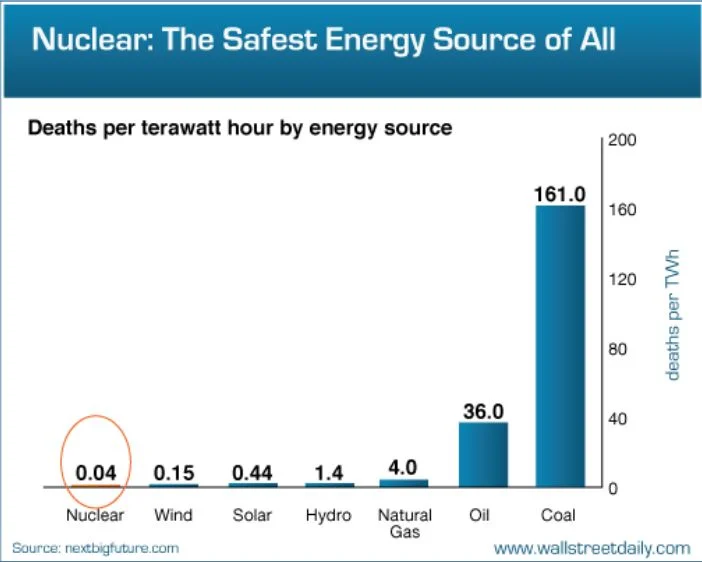
I had no clue about these numbers until I watched Pandora's Promise.
As you can see, according to these numbers, nuclear energy is actually the safest of the major sources of energy. With all the press about Chernobyl, Three Mile Island, and the closure of nuclear plants, you would think that nuclear would be about as dangerous as oil coal, if not more so. Well, this reaffirmed my view that we ought to take a look at the numbers behind arguments before jumping to any conclusions. The film also persuasively argued that the closure of a nuclear power plant (or the failure to build one) results in more use of fossil fuel sources than would occur otherwise. As Steven Pinker's tweet below argues, we might not be drilling for as much oil and natural gas currently if we hadn't stopped expanding nuclear power decades ago.
Josh Goldstein: If activists hadn't blocked nuclear power 40 years ago they wouldn't have to protest pipelines today https://t.co/CwQPToiJVF
— Steven Pinker (@sapinker) May 18, 2017
The anti-nuclear power camp argues that we do not need nuclear and can reach near zero emissions through other renewable sources. They usually cite a paper by Stanford engineering professor Mark Jacobson, in which he outlines the path to sustainable energy (with no nuclear energy necessary) by 2030. While this paper appears credible at first glance, several critiques have been published that argue it fails to address problems such as intermittence, storage, and scalability that come with wind, hydroelectric, and solar technologies. Since I am obviously unqualified to judge the intricacies of technological viability on my own, I defer to trusting sources that emphasize realism and quantitative assessment—traits that I can attest are often missing from sects of the environmental movement.
No matter your stance on the topic, I recommend the film for anyone that seeks to transcend trite media portrayals and that is willing to hear a well-constructed, rational argument.

Tristan Harris on Reclaiming Attention in the Age of Distraction
How can we use technology to spend our time well?
In this podcast, Sam Harris sits down with Tristan Harris, former Design Ethicist at Google and founder of Time Well Spent, a group that works to bring consciousness and intentionality to our technological lives, which are undoubtedly overrun with distraction and outside manipulation. As discussed in this episode, most of us (myself included) are to some degree led around by the nose by the engineers at Facebook, YouTube, Snapchat, and other companies, as the current attention economy rewards clicks and eyeballs, rather than lasting satisfaction or value. Harris really wants to change the dominant conversation in Silicon Valley from topics like time on site and ad revenue to ones like how smart technology design can truly help people live more fulfilling lives. He is one of thew few people I've encountered who recognizes the importance of this problem and is committed to making technology work for us in ways that help us live the lives that we really want, which unquestionably includes spending our time well. To be clear, he is not interested in telling us whether Headspace is a better use of our time than a Weight Watchers app (which includes a subjective value judgment), but he is urging us to consciously decide how much time (if any) we would like to spend on each, rather than falling prey to whichever app screams the loudest.
Most of us would agree that how spend our time represents what we value, but many of us might not feel great about how much time we log on something like Facebook. While we might get some momentary satisfaction out of scrolling through our news feeds for the latest outrage and political tumult, many of us later come to regret spending an inordinate amount of time on it. Apps like Moment seek to bring these facts to consciousness, forcing us to confront the cold, hard numbers of how much time we spend on our phones. In Harris' view, if we can take an honest look at statistics like these and ask ourselves "How much time per week would we like to spend on Facebook?", we can then make design choices to achieve that end. To clarify, it's not all about just avoiding our phones, as he concedes that certain apps like Headspace can make a legitimate case that they are a good use of our time. Rather, it is about creating a choice architecture that will serve our own consciously constructed goals, rather than those of advertisers and private companies. Obviously, many financial relationships (namely, the ad-based economy) will have to change if this is to be realized. Harris thinks this is a price well worth paying and I could not agree more.
As I often find myself aimlessly scrolling on Facebook even though I consciously know there are better uses of my time, I found this conversation extremely insightful and necessary. I hope you enjoy it as well.

Getting the "Cult" Out of Permaculture
Permaculture undoubtedly offers some promising ideas for more sustainable living, but there are dogmas within the movement that shield these ideas from scrutiny.
Over the last year, I have visited a number of permaculture centers and learned a bit about the history and trajectory of the movement. I have found quite a lot to like and met some very intelligent, hardworking, remarkable people. Notwithstanding, I ran into an ideological hornet's nest quite a few times on a variety of issues, undoubtedly due to both my skeptical, inquisitive nature and my gravitation to controversy. I also must say that, at times, the opposition to my questioning felt cultish, not in the sense that any nefarious plans were being drawn in secret, but in the sense that devotion to certain principles was beyond any criticism and unworthy of examination, as well as a sense that the movement drew in people more based on its ability to provide an emotionally satisfying narrative rather than an attraction to substantive ideas. I would like to also add the caveat that the following criticisms hardly apply to everyone I met in these circles, as many were actually quite welcoming of my questions and even shared some of my concerns. However, I felt there was a substantial portion of people who did, at times, deserve these criticisms.
Permaculture, as founder Bill Mollison defined it, does not appear to take any particular issue with science or skepticism (Mollison voiced his disdain for spiritualism). But one thing that nearly everyone seems to agree on is that permaculture lacks a clear, agreed upon definition—an issue that could elicit charges of obscurantism and a resistance to scrutiny. In any case, perhaps its most accepted (and uncontroversial) is a social and agricultural system utilizing the patterns and systems used in nature. The claim is that these systems, if properly constructed, would not only be sustainable but would be truly regenerative. That is, not only would they allow for human settlements to sustain themselves, the system would create perpetual and autocatalytic improvements over time. Instead of conventional agriculture, which degrades the soil quality and presents a host of environmental problems, permaculture's agriculture aims for low-input, hight-output production that improves biodiversity, soil quality, and many other aspects of the environment. This is a seemingly unexceptionable goal and creates an immediately attractive basis for the movement. The question of whether permaculture can truly deliver on this goal (namely, feeding and meeting the energy demands of a world with seven billion people), is hotly debated, and unlikely to be resolved any time soon (frankly, I am skeptical, but would love to be proven wrong).
What can be more immediately addressed is the importance of permaculture projecting a reputable, science-based image, lest it confirm the most negative stereotypes of the movement as a bunch of hippies puttering around in an unproductive garden and cherishing an illusory self-sufficiency. In a scathing critique of polyannaish, New Age thinking, Ireland-based permaculture teacher Graham Strouts recalls a story of a group hoping to collect data at a permaculture homestead, only to be rejected because they were, "just not interested, that's not what [permaculture] is about."
I confess that this story does not surprise me, as I frequently ran into the criticism that "Western science" was "reductionist", unable to keep up with the complexity of permaculture, and an unnecessary endeavor in refining permaculture principles and practices. I have no doubt that if this attitude dominates within permaculture circles, it will remain a niche subculture with little impact. As a skeptic with a sincere interest in finding solutions to environmental problems, I want permaculture's best ideas to succeed but its resistance to mainstream assimilation, namely, a reluctance (or indifference) to submit itself to the rigors of science, is frustrating. I am all for creating a system that allows both humans and the earth to flourish, but just wishing an idea to be true does not make it so. There are some areas where permaculture's approach has yet to be documented in the scientific literature, and this lack creates a nagging anxiety within me, particularly when some thrust permaculture up as our only salvation.
This semi-religious fervor haunted me for much of my time visiting these centers and it is not so much the content of permaculture, strictly speaking, that advises this cultish mentality but the intellectual spheres that surround permaculture. As with all philosophies and movements, the space between their textbook definition and how that actually manifests can be enormous. I have repeatedly run into flagrant appeals to nature when discussing topics like GMO's, geoengineering, vaccination, and the like. Some also appear to setup a Manichaeism between the enlightened "permies" and ignorant outsiders. Sadly, various conspiracies were commonly trotted out, including, but not limited to, UFO's, 9/11 Truth, chemtrails, repression of cancer cures, and rigged elections.
Unsurprisingly, I am not the first to remark on such an ideological morass, and people far more qualified and experienced with the movement have diagnosed this issue. In particular, I recommend researcher Peter Harper's piece "Permaculture: The Big Rock Candy Mountain", as not only does he apply incisive analysis, he has 30+ years of experience within the movement.
“A cynic would say this lack of quantitative testing [within permaculture] is not accidental, because it might reveal that many favourite notions are false, or at least not what they are cracked up to be. Most people attracted to Permaculture are young, dreamy idealists looking for some kind of system to structure their activities and impart meaning. It does not matter much whether things ‘work’ because you are not obliged to depend on them. It is their symbolic value that counts. I have encountered numerous ‘permaculture gardens’ with abysmal levels of productivity that have nevertheless persuaded their creators that they are virtually self-sufficient in food. A few measurements and numbers would quickly dispel this illusion, but Permies just don’t do numbers.
In this respect I am sorry to say that the Permaculture movement has not taken itself seriously. This is a pity because it really could have a lot to offer.”
Thankfully, there are those in the movement who are interested in quantifiable analysis. Rafter Sass Ferguson, a Ph.D in Crop Sciences, is trying to bring more quantitative data to permaculture. Although it appears that Rafter and I would disagree on issues like GMO's (I think GMO's could be used effectively alongside permaculture techniques), I strongly support his (and others') efforts in this regard and hopefully many more will follow. This kind of research and scrutiny is the only way permaculture will overcome its cultish affiliations and substantiate its principles with evidence. If permaculture is all that its most devoted proponents say it is cracked up to be, there is nothing to fear from such investigation. Moreover, this is the only path to its proliferation and widespread acceptance.
Other efforts for research and quantification in permaculture:
The Savannah Institute